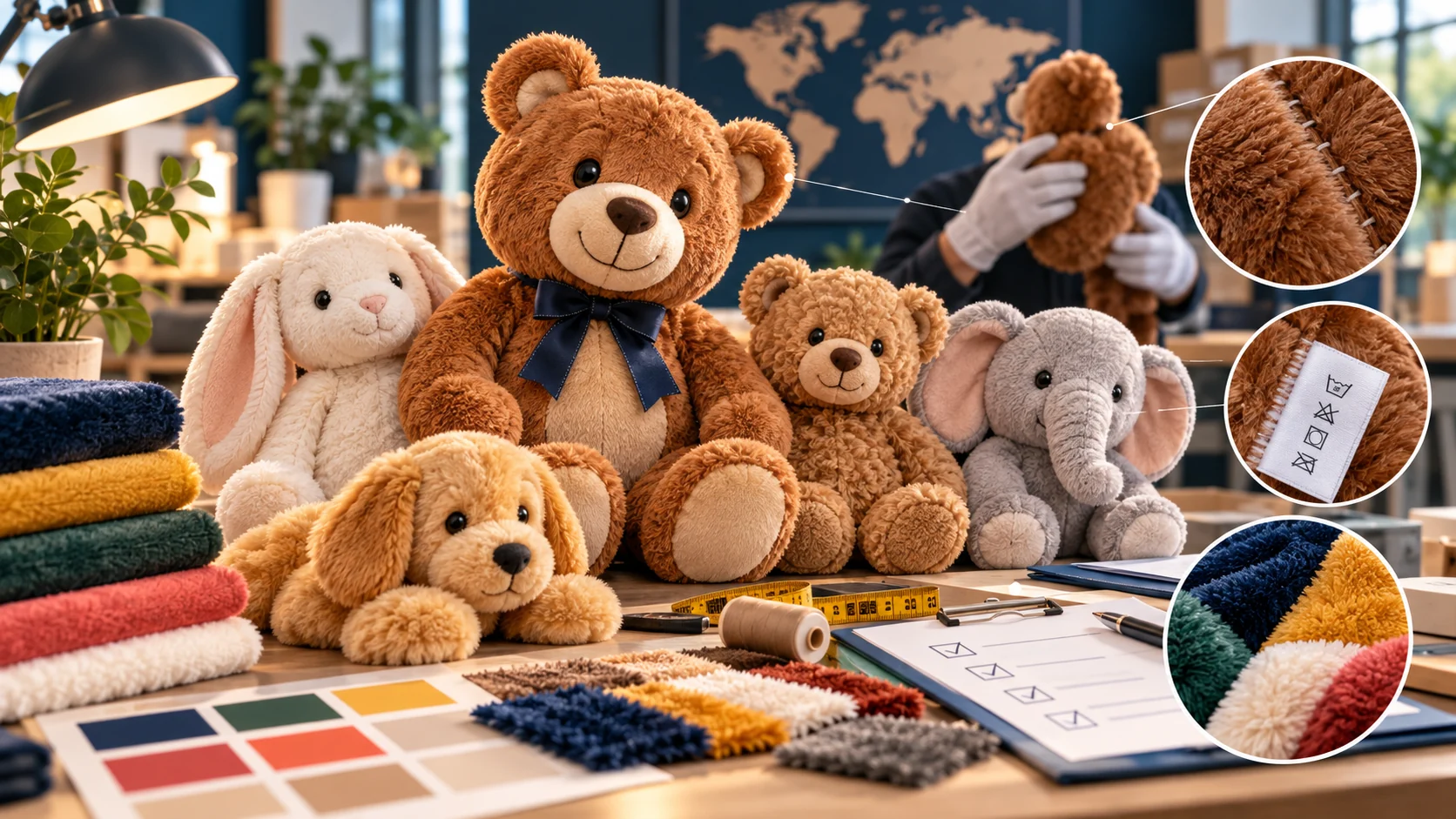
Plush toys are often used for years. They are hugged, carried, dropped and washed. This makes construction, materials and labelling just as important as appearance, especially when a company commissions a custom stuffed animal for retail, merchandise or promotion.
Check stitching, eyes, noses, accessories and components that may detach.
Check that age information and required warnings match the toy and its intended use.
Products and responsible economic operators need to be identifiable.
What does EN 71 mean for plush toys?
EN 71 is a family of European toy-safety standards. Relevant areas for stuffed toys can include physical and mechanical properties, flammability and the migration of certain elements. The appropriate tests depend on the design, materials, intended age range and foreseeable use of the product.
Simply listing “EN 71” in a product sheet is not enough. The manufacturer must assess safety and maintain evidence that applicable requirements are met. Seams, attached parts, small components and material performance are among the aspects to consider.
CE marking is not an independent quality certificate
Toys covered by EU toy-safety legislation must bear the CE marking. The marking indicates that the manufacturer takes responsibility for meeting the applicable requirements; it does not automatically mean that a public authority has tested or pre-approved every product.
Business buyers should consider the supporting technical documentation, product identification and relevant test evidence, as appropriate. For custom-made toys, these questions are best addressed during the design stage.
Age warnings and children under three
A “Not suitable for children under 36 months” warning must be justified by the product’s intended and foreseeable use and actual risks. It should not be added routinely to bypass safety requirements. Soft, cuddly toys may be especially attractive to very young children, even if marketed to a different audience.
Cleanability and suitable washing information may also matter for soft and textile toys, especially those intended for young children. The cleaning method should be appropriate to the product.
Check labelling and traceability
- CE marking where required by applicable toy-safety rules.
- Manufacturer identification and contact details, plus importer details when applicable.
- A product, model, item or batch identifier for traceability.
- Relevant warnings and safety instructions in the required language.
- Appropriate care information and washing instructions.
Developing a custom plush toy
Harlequin Trade helps companies turn illustrations into prototypes, production-ready soft toys, labelled products and deliveries. Material choices, attached parts, testing and documentation can be planned from the outset.
Looking for a custom teddy bear, club mascot or entirely new character? See our custom plush toy manufacturing service or send us a sketch.
Frequently asked questions
Do plush toys need CE marking?
When a stuffed animal is classified as a toy within the scope of EU toy-safety legislation, it must meet the relevant requirements and carry the CE marking.
Does CE marking prove a laboratory has tested the toy?
No. It represents the manufacturer’s declaration of conformity, backed by appropriate documentation.
Can a plush toy simply say “Not suitable under 3”?
That warning must be justified by actual hazards and the toy’s intended and reasonably foreseeable use.
Can you help us consider safety in a custom design?
We can discuss relevant requirements during product development and coordinate testing or documentation where appropriate.
Further reading: European Commission information on toy safety. This guide is general information and does not replace a product-specific risk assessment.
Planning your own plush toy?
We help align appearance, materials, intended use and applicable safety requirements. Share your idea and target volume to discuss the next steps.
Request a quotation ↗